





For international B2B buyers, receiving a high-quality sample is a good start. But one successful sample does not guarantee that every future order will deliver the same results.
When a distributor purchases multiple containers of PE fabric, or an OEM customer requires consistent material specifications for ongoing production, manufacturing consistency becomes just as important as the product itself.
Differences in fabric weight, roll dimensions, coating quality, strength or packaging can create problems throughout the supply chain. They may affect product fabrication, installation, customer satisfaction and repeat purchasing.
This is why a reliable PE fabric manufacturing process should involve more than a final inspection.
At YGM, we focus on the full manufacturing and supply process, from material preparation and fabric production to quality inspection, custom manufacturing, export packaging and container loading.
Our approach is built around a straightforward principle: quality should be considered at every stage of production, not only when the finished fabric leaves the factory.
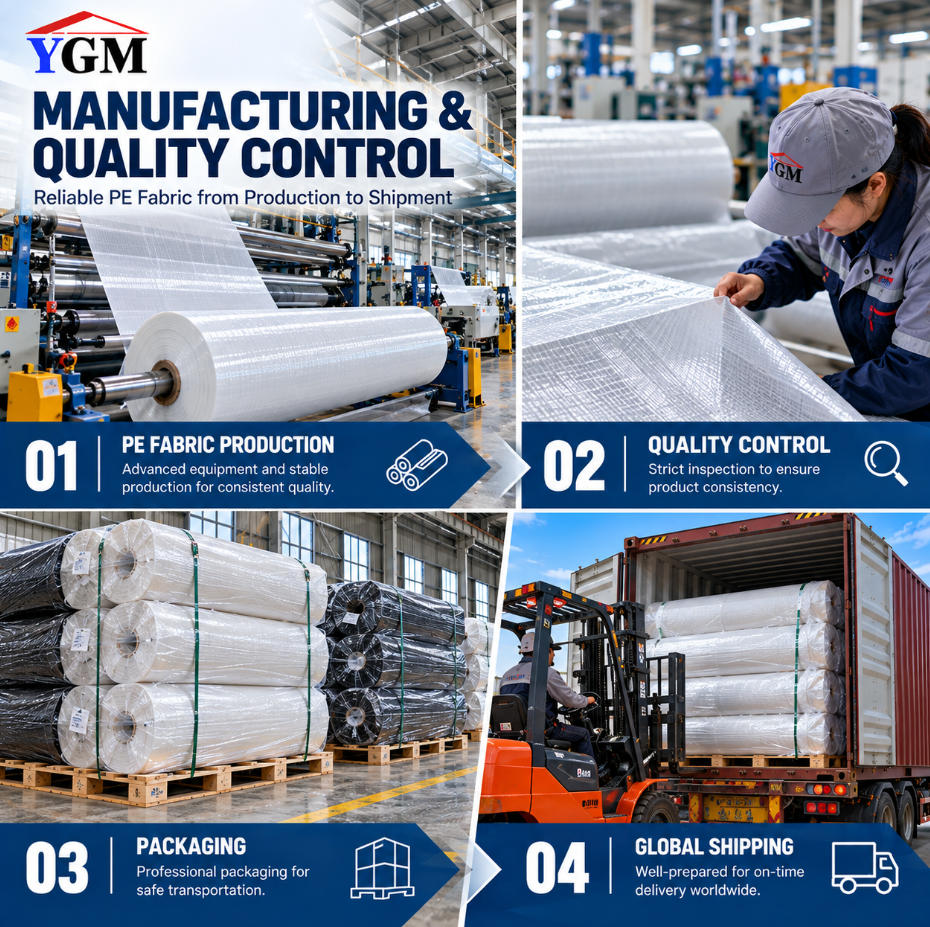
Why Manufacturing Consistency Matters for PE Fabric Buyers
PE fabric is used in a wide range of industrial, agricultural, construction and outdoor protection applications.
Depending on the product, customers may require specific combinations of strength, waterproof performance, UV stability, dimensional accuracy and lightweight handling.
For example, a warehouse cover manufacturer may need fabric that maintains consistent dimensions during panel fabrication. An agricultural distributor may require repeat orders with the same roll width, color and packaging. An industrial covering supplier may need reliable material performance across several product batches.
These requirements make manufacturing consistency essential.
For professional buyers, inconsistent production can lead to:
- Differences between approved samples and bulk orders
- Unexpected changes in material weight or thickness
- Fabrication and installation difficulties
- Inconsistent roll dimensions
- Variations in appearance or surface finish
- Additional inspection and handling costs
- Delays in OEM production schedules
- Customer complaints and replacement requests
A well-managed production process helps manufacturers identify potential problems earlier and maintain better control over agreed specifications.
Understanding the PE Fabric Manufacturing Process
The manufacturing process for woven PE fabric generally involves preparing polyethylene materials, producing tapes, weaving the base fabric and applying finishing processes according to the required product structure.
Not every PE fabric follows exactly the same production route. Some products require coating or lamination, while others are designed with different woven structures, reinforcement methods or finishing requirements.
For buyers, understanding these differences helps explain why two fabrics with similar GSM values may perform differently.
A typical woven PE fabric manufacturing workflow may include:
Raw Material Preparation → Tape Extrusion → Weaving → Coating or Lamination (Where Required) → Inspection → Cutting or Finishing → Packaging → Shipment
Each stage can influence the characteristics of the final product.
1. Material Preparation: Quality Begins Before Production
The first step in producing reliable PE fabric is selecting the appropriate materials for the intended application.
Different products can require different polyethylene formulations, material structures and additives.
For example:
- Outdoor protective covers may require UV stabilization.
- Waterproof tarpaulin products may require suitable lamination or coating.
- Industrial covering materials may require increased tensile or tear resistance.
- Agricultural fabrics may require specific handling and outdoor performance characteristics.
- Lightweight structural fabrics may need an appropriate balance between strength and material weight.
Material selection should therefore begin with the end-use application.
At YGM, product requirements help guide discussions around material specifications and manufacturing arrangements.
For international buyers, clearly defining the intended application before production helps establish expectations for the finished material.
2. Tape Extrusion: Building the Foundation of Woven PE Fabric
Tape extrusion is an important production stage for many woven PE fabric products.
In a typical process, polyethylene material is melted, extruded into film, cooled, slit into tapes and stretched under controlled conditions.
These tapes form the foundation of the woven fabric.
Tape characteristics can influence several important properties, including:
- Tensile performance
- Fabric weight
- Weaving consistency
- Material uniformity
- Strength-to-weight balance
- Finished fabric performance
The relationship between tape properties and finished fabric performance is especially important in industrial applications.
For distributors and OEM buyers, consistent tape production supports more predictable fabric characteristics across orders.
3. Fabric Weaving: Creating Strength Through Structure
After tape preparation, the material is woven into a fabric structure.
The weaving process determines how the individual tapes are arranged and interlaced.
Different weaving configurations can influence fabric strength, stability, flexibility and weight.
Important manufacturing considerations may include:
- Warp and weft arrangement
- Weaving density
- Fabric width
- Tension consistency
- Woven structure uniformity
- Finished fabric appearance
For applications such as industrial covers, warehouse protection and agricultural covering, the woven structure plays a significant role in the overall performance of the product.
A consistent woven structure also helps downstream manufacturers cut, fabricate and assemble protective covers more predictably.
4. Coating and Lamination: Matching the Fabric to Its Application
Many PE tarpaulin and industrial covering products use coating or lamination processes to achieve specific surface and protection characteristics.
Depending on product design, these finishing processes can contribute to:
- Waterproof performance
- Surface consistency
- Resistance to moisture penetration
- Protection of the woven base
- Product appearance
- Handling characteristics
However, coating and lamination requirements vary according to the product category.
A waterproof outdoor tarp, for example, has different performance requirements from a permeable agricultural ground cover or a specialized construction fabric.
This is why buyers should avoid assuming that all PE fabric products have the same surface treatment or functional performance.
At the sourcing stage, confirming the intended product structure helps prevent misunderstandings between buyers and manufacturers.
5. Quality Inspection: More Than Checking Finished Rolls
Quality inspection is an essential part of reliable PE fabric manufacturing.
For professional buyers, the goal is not simply to receive material that looks acceptable. It is to receive products that consistently match the agreed order requirements.
Depending on the product and inspection agreement, relevant quality checks may include:
Fabric Weight
GSM, or grams per square meter, is a common specification used in technical fabric purchasing.
Checking fabric weight helps determine whether production is consistent with the agreed material specification.
However, GSM alone does not demonstrate tensile strength, tear resistance or outdoor durability.
Roll Width and Length
Accurate dimensions are important for manufacturers, distributors and project suppliers.
Incorrect roll dimensions can affect fabrication planning, material yield, installation and inventory management.
Appearance and Surface Condition
Visual inspection can help identify weaving irregularities, coating defects, contamination or other visible issues.
Tensile and Tear Strength
Where required, mechanical testing helps assess whether the fabric meets the specified strength criteria.
Waterproof Performance
For waterproof products, appropriate testing helps confirm relevant water-resistance characteristics.
UV Resistance
For outdoor applications, buyers may request supporting test information relating to UV exposure and material performance.
Packaging and Labeling
Finished rolls should also be checked against agreed packaging, labeling and quantity requirements.
The purpose of these checks is to identify differences between the expected and actual product before the order enters the next stage of the supply chain.
For buyers, the most useful quality documentation is evidence connected to the actual specification and applicable test method—not simply a general claim of high quality.
6. Custom PE Fabric Manufacturing for Different Industries
One of the challenges in industrial fabric sourcing is that different applications require different product configurations.
A general-purpose tarp may not be suitable for the same conditions as a structural warehouse cover. An agricultural crop protection product may require a different structure from a waterproof machinery cover.
YGM supports customized PE fabric manufacturing for different professional applications.
Depending on the product category and production requirements, customization can include:
- Fabric weight and structure
- Roll width and length
- Finished sheet dimensions
- Color
- Waterproof coating or lamination
- UV-resistant options
- Reinforcement and edge finishing
- Eyelets or other fixing arrangements
- Printing and branding
- OEM and private-label packaging
- Export packaging configurations
For international distributors and OEM customers, customization creates opportunities to develop products aligned with local market demand.
Rather than simply buying a standard roll of material, customers can work toward a defined product specification and supply arrangement.
7. Manufacturing PE Fabric for Different Applications
YGM’s PE fabric portfolio supports a wide range of professional applications.
Industrial Protection
Industrial protective fabrics are used to help cover machinery, tools, equipment and outdoor materials.
Buyers may prioritize waterproof performance, tear resistance, UV stability and repeated handling durability.
Warehouse and Storage Covers
Warehouse and storage applications can require large fabric panels and durable outdoor protection.
For these products, dimensional consistency, fabric strength and installation efficiency are important considerations.
Agricultural Protection
Agricultural PE fabric products may be used for crop protection, farm equipment covering, hay covering, outdoor storage and transportation.
Material selection depends on the intended use. For example, a waterproof machinery cover requires different performance characteristics from a breathable or permeable crop protection product.
Construction Applications
PE-based materials are used in several construction-related categories, including house wrap, scaffolding sheeting, roofing underlayments, concrete curing covers and general jobsite protection.
Each specialized construction product requires its own relevant performance criteria and, where applicable, regulatory or project compliance documentation.
Engineered Structural Fabric
YGM STRUX™ Engineered PE Structural Fabric is developed for fabric buildings, industrial shelters, warehouse covers and agricultural structures.
These applications place particular emphasis on strength, lightweight handling, dimensional consistency and outdoor durability.
For project manufacturers, stable fabric characteristics help support consistent fabrication and installation processes.
8. OEM Manufacturing: Why Repeatability Is Important
OEM customers often require more than a single successful delivery.
Their products may be sold under their own brands or incorporated into finished goods, which makes repeatability essential.
For example, an OEM customer may require:
- The same material specification across production batches
- Consistent roll dimensions
- Standardized product printing
- Agreed labeling and packaging
- Predictable order preparation
- Reliable communication before shipment
When these requirements are not clearly documented, even small changes can create problems for downstream operations.
A practical OEM sourcing process should begin with confirming the approved specifications and customization requirements.
These details then become a reference for manufacturing, inspection, packaging and repeat-order communication.
At YGM, we work with OEM buyers to develop PE fabric solutions around actual product and market requirements.
9. Export Packaging and Container Loading
Manufacturing quality does not end when a roll leaves the production line.
PE fabric products must still be packed, handled, stored and transported before they reach the customer.
Improper packaging may expose finished goods to damage, contamination or handling difficulties during transportation.
YGM prepares export orders in configurations based on product and customer requirements, including:
- PE fabric rolls
- Protective roll packaging
- Palletized goods
- Reinforced packaging arrangements
- Customized labeling
- OEM packaging
- Mixed product configurations
- Container-loading preparation
Efficient loading should consider roll dimensions, packaging formats, weight distribution, container limits and unloading requirements.
For distributors and importers, packaging and loading decisions can affect warehouse efficiency and the condition of goods upon arrival.
A reliable manufacturing partner should therefore understand how production requirements connect with logistics and delivery preparation.
10. Why Reliable Supply Matters for Long-Term B2B Cooperation
For many customers, the first order is only the beginning.
Building-material distributors, agricultural suppliers, industrial fabric importers and OEM brands often depend on repeat purchasing.
A long-term PE fabric supplier should support clear communication around:
- Product specifications
- Production planning
- Order quantities
- Custom requirements
- Inspection expectations
- Packaging
- Shipment preparation
- Repeat order consistency
Stable supply helps customers manage inventory, plan market distribution and respond to their own customers more effectively.
At YGM, our aim is to connect manufacturing capability with practical export preparation and long-term B2B cooperation.
How to Evaluate a PE Fabric Manufacturer
Choosing a manufacturing partner involves more than reviewing a sample and requesting a quotation.
Before committing to a large order, professional buyers should evaluate several areas.
| Evaluation factor | What buyers should confirm |
|---|---|
| Product specification | Weight, structure, dimensions and required performance |
| Manufacturing capability | Ability to produce the specified product |
| Quality inspection | Relevant checks, tolerances and test requirements |
| Customization | OEM branding, sizing, finishing and packaging |
| Production consistency | Procedures for maintaining repeat-order specifications |
| Export preparation | Roll packaging, palletizing and loading arrangements |
| Communication | Clear approval processes and handling of changes |
| Supply planning | Ability to support the required quantities and schedules |
For higher-value industrial applications, buyers should also request relevant samples, technical data and performance testing where necessary.
The objective is to establish whether the manufacturer can consistently supply the correct product—not merely offer an attractive unit price.
Common Mistakes When Sourcing PE Fabric
Selecting a Supplier Based Only on Price
A low quotation may appear attractive, but it does not automatically demonstrate suitable material performance, manufacturing control or long-term supply capability.
Relying Only on the First Sample
A sample is useful for initial evaluation, but buyers should also establish agreed specifications and acceptance criteria for bulk production.
Focusing Only on GSM
Two PE fabrics with the same GSM may have different woven structures, coatings and performance characteristics.
Ignoring Roll Dimensions and Tolerances
Dimensions matter for cutting, fabrication, packaging and installation. Tolerances should be agreed upon before production.
Overlooking OEM Packaging Requirements
Printing, labels, roll arrangement and packaging should be confirmed early to avoid unnecessary changes during order preparation.
Failing to Plan Repeat Orders
Long-term B2B purchasing benefits from clear specification records and communication about future supply requirements.
The Connection Between Quality Control and Customer Confidence
Reliable manufacturing is closely connected to customer trust.
When buyers repeatedly receive products matching the agreed specifications, they can plan distribution and production with greater confidence.
This relationship between process control, consistent output and customer confidence is also reflected in widely recognized quality-management principles. The ISO framework emphasizes a process-based approach rather than relying exclusively on end-product inspection.
For PE fabric manufacturing, the practical lesson is clear: the quality of the finished product depends on how the entire process is managed.
Quality should be considered when defining materials, producing fabric, checking finished goods and preparing export orders.
Frequently Asked Questions
What is the manufacturing process of woven PE fabric?
A typical process includes raw material preparation, tape extrusion, weaving, coating or lamination where required, inspection, finishing, packaging and shipment. The actual process depends on the product structure.
Why is quality control important in PE fabric manufacturing?
Quality control helps verify whether manufactured products meet agreed requirements for weight, dimensions, appearance, strength and other relevant characteristics. This is especially important for large orders and repeat supply.
Does higher GSM always mean better PE fabric?
No. GSM indicates material weight per unit area but does not fully determine performance. Woven structure, material formulation, coating, UV stabilization and strength characteristics should also be evaluated.
Can YGM manufacture customized PE fabric?
YGM supports customized PE fabric solutions according to product and application requirements, including widths, sizes, specifications, branding and packaging.
What industries use YGM PE fabric solutions?
YGM serves industrial protection, warehouse and storage, agriculture, construction, transportation and other professional outdoor protection applications.
What should OEM buyers confirm before placing an order?
OEM buyers should confirm the intended application, specifications, dimensions, performance requirements, printing, labeling, packaging, quantity and repeat-order expectations.
How can buyers evaluate manufacturing consistency?
Buyers can request agreed product tolerances, relevant inspection information, production samples where appropriate, and clear procedures for handling specification changes.
Why does packaging matter for industrial PE fabric?
Packaging helps protect fabric during storage and transportation, supports organized loading and unloading, and helps distributors manage inventory and product presentation.
Quality Is Built Throughout the Process
Reliable PE fabric manufacturing is not defined by one sample, one production step or one final inspection.
It comes from understanding the application, confirming the specification, managing production, checking finished goods and preparing orders for delivery.
For distributors, importers, contractors and OEM buyers, a dependable manufacturing partner can help reduce sourcing uncertainty and support long-term business development.
At YGM, we focus on connecting professional PE fabric manufacturing with customized product requirements and international supply.
From industrial protection and warehouse covers to agriculture, construction and engineered structural fabrics, our goal is to provide PE fabric solutions that meet real-world requirements.
Quality isn’t just a final inspection. It’s part of the entire process.
Looking for a reliable PE fabric manufacturing partner?
Tell us your application, specifications, required dimensions, order quantity and destination market. Our team will help you discuss the appropriate product and manufacturing requirements.
Website: https://www.ygmtarp.com/
Email: sales@ygmtarp.com
YGM — Reliable Fabric Solutions. Built for Long-Term Partnership.